Thursday, December 20, 2012

Skyfall Review

Shocking
Ryan Gilliam 


In 1962, Dr. No was released to the world, and the Bond film franchise was born. Now on its 23rd official installment, and its sixth Bond actor, Skyfall has landed a huge success. While there have certainly been excellent Bond films in the past, Skyfall sores above the others.


In Skyfall, we see the return of Daniel Craig as Bond (the pistol wielding, ass kicking, sex magnet, super spy of MI6), and Dame Judi Dench as M (the aging, fiery, head of all the British secret service). In addition to these familiar faces, we are introduced to Eve (Naomie Harris), a fellow agent of Bond's, Gareth Mallory (Ralph Fiennes), a bureaucrat who at first seems more foe than friend, and most importantly, Silva (Javier Bardem), the dark, psychotic villain. All five of these actors play their parts beautifully, surpassing the performances in any Bond film of recent memory.


Skyfall shows the audience a damaged and aging Bond, who is thrown off his game after being pronounced dead within the first ten minutes of the film. After his “resurrection”, we are treated to watching the usually precise and perfect 007 falter in many of his usually natural tasks due to being shot multiple times. The humanizing and vulnerability of Bond is something that was briefly seen in 2006’s Casino Royale, but wasn't quite explored to fruition. Finally, six years later, we get to see the world's favorite spy suffer in more ways than the loss of a loved one. 


As per Bond tradition, we are treated to a menacing and evil villain in Silva. Javier Bardem manages to steal every scene he is in. Whether through his dialogue, or small mannerisms, he is entrancing to watch. He demands the audience's attention in a way that was last seen with the late Heath Ledger’s Joker in Christopher Nolan's The Dark Knight.


While Silva steals the show, the real praise is to be given to Dame Judi Dench and Daniel Craig. This Bond film truly shows the unique relationship between M and Bond. There is an unspoken mother to son love between the two that is dealt with so beautifully. Bond and M spend most of the third act together. This allows the audience to, for the first time in series history, see their relationship as more than a voice in the ear of a killer.


From suave one-liners, to crippling insanity, the script really propels the actors into glory. The movie has significant depth to its story and characters, while still feeling reminiscent of its legacy. The jokes never feel forced, and the occasionally solemn tone is a welcome addition to the campy Bonds of yesteryear.


The conflict between Bond and the villainous henchmen always happen in an interesting environment. From an unfinished Shanghai skyscraper, to a mansion in Scotland, to a pit inhabited by Komodo Dragons, Skyfall is never boring to watch. The film is beautiful, ascetically speaking, with crisp colors and superb camera shots. Director Sam Menedes really puts his best foot forward, and his hand is seen through every aspect of this film. The trademark world travels of the famous British spy only really appear in the first half of the film. The bulk of Skyfall takes place in London and Scotland, all too familiar terrains for Bond.


The ending is satisfying in a way that lends closure to those who need it and excites for what is to come. The last five minutes will interest anyone enough to come back to Bond next time, and fans of the classic Connery Bond will find themselves squealing with memory-induced delight. The next few years will be filled with impatience as we eagerly await Bond 24.

Conclusion:

Skyfall is an excellent film for fans of the Bond series and new comers alike. Unlike many other action flicks, there is depth to every character and motivation for every explosion. Skyfall has set a new bar for Bond films in the future. While things have always changed throughout 007's legacy, this film is truly shaken, not stirred.


Smashed Review

Live's Worth Saving
Austen Goslin


Smashed is about the addicted, not the addiction. Too often films about alcoholism can turn into sermons on the evils of the drink. Smashed is the rare one that brings a bit of negative bitterness towards sobriety.

Smashed follows the young couple of Kate (Mary Elizabeth Winstead) and Charlie (Aaron Paul) Hannah. For them every night is a party and happy hour lasts from dusk till dawn. Their string of ceaseless drinking is only halted by the occasional need for sleep and for Kate's first grade teaching job.

The crux of the story comes with Kate's Momento Mori, which happens to come in the form of throwing up in front of first graders. It's from here that Smashed turns into something truly special. Forgoing standard addiction fair Smashed tells the story of Kate's long road to sobriety with an emphasis on the downsides.

Surrounded by a quasi AA group of an elder generation Kate moves closer to sobriety  We see the effects on friends and family, as well as the tole it takes on her. In this group she is shepherded along her difficult journey by a stellar cast led by Octavia Spencer and NickOfferman.

Throughout her story, Kate suffers heart break at every turn. As Kate tries to find fun in sobriety and retain the friends she knew from drinking,we are shown why sobriety is so difficult. It is an amazing movie that can turn a viewer so starkly against the concept of sobriety.

There is a special feeling contained in every defeat Kate faces, one that viewers can't help but be pulled into. The film always feels strikingly genuine, in a way that seems born out of shared experience between creator and character. Each moment is handled gracefully by script that loves each of it's characters.

These moments are handled with grace by director, James Ponsoldt. He allows the story to be told through the performances rather than asserting selfish  heavy handed presence. Ponsoldt clearly holds the material he is working with in the highest regard, and never tries to tamper too heavily with it. This helps a great deal with the genuine and honest feel that permeates every aspect of the film.

It is this honesty that keeps Smashed from falling into the stereotypical ruts of a recovery story. Watching Winstead crawl from wreckage of Kate's lies and successes is an experience that can only truly be described as human. This humanity is quite possibly the best success of Smashed.

Ina film loaded throughout, with incredible performances, it is the truth in the relationship between Kate and Charlie that truly shines. Winstead and Paul work perfectly off of each other with a chemistry that never feels forced. Seeing young actors perform with such staggering talent is a treat that inspires hope for the future of films.

If there is fault to be found in Smashed, it lies within the story.While the primary story is told with great effectiveness, side stories are often dropped with only a passing mention. This scripting inconsistency could easily be damning for some films, however in the end  the charm and heart of Smashed helps it to easily over come it's few faults.

Smashed is a rare film that handles a heavy topic with brevity and truth. It never allows the viewers attention to slip, and in such a human story  this is a phenomenal feat. Every aspect helps to lend the films quality and depth sadly absent from the majority of major films.Smashed is an honest and beautiful look at the problems of fixing life.


Tuesday, December 18, 2012

Dishonored Review


A Knife in the Dark
Ryan Gilliam

To be asked to describe Dishonored, is similar to being asked to describe a priceless
painting. It is beautiful, and is almost unanimously praised, yet everyone experiences it
so differently. When one person looks at a painting, they may feel very differently than
the last person who viewed the exact same painting. This is a very similar experience to
Dishonored.

Just like many paintings, Dishonored creates a fresh, new world for the player to learn
about and explore. The quality of Dishonored’s fiction is something gamers have not
experienced since 2007 when Bioshock was first released. Dunwall, the city the game
takes place in, is a whaling city, and the hunting of whales brings the fuel for most
technology in the world. The setting and universe feel unique and unexperienced. It
gives the player an erie sense of unease while still exciting them enough to explore both
the the darkest alley and the highest castle.

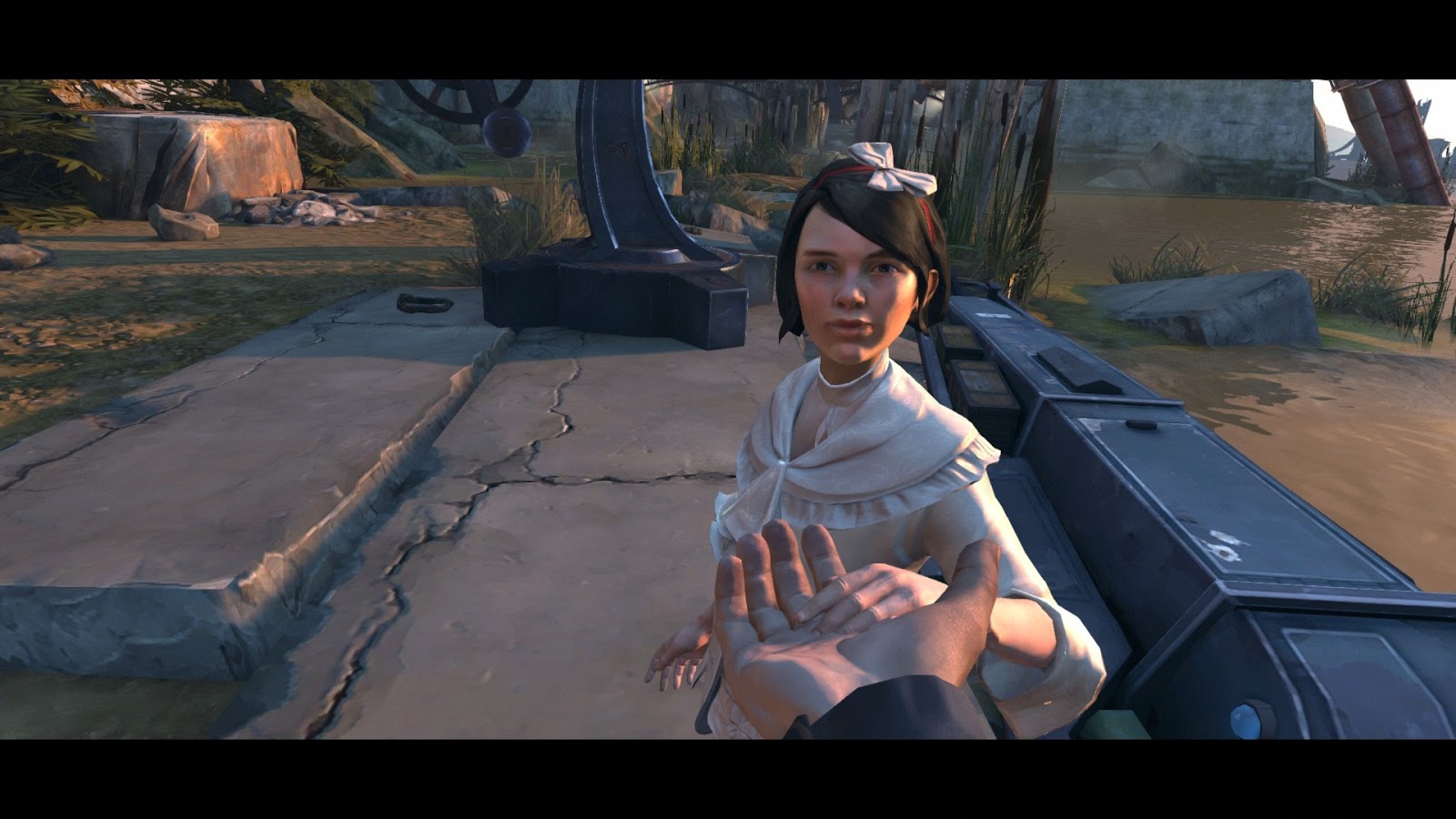
The city of Dunwall is ruled by the Empress and her young daughter Lady Emily. The
player experiences the game through the eyes of Corvo Attano, The Empress's
personal body guard and Lord Protector of Dunwall. Within the first ten minutes of the
game, after one of the best tutorials I have ever experienced, the player is treated to a
cutscene in which the Empress is murdered, Lady Emily is kidnapped, and Corvo is
blamed for everything. Corvo wakes up in the Dunwall Jail, merely hours away from his
set execution. This readies the player excellently, giving them a firm motivation for the
missions ahead.
Dishonored is, to some, a stealth game, and to others, a first person action title. Imagine
a game with the first person free-running of Mirrors Edge, the plasmids from Bioshock,
and the mission structure of Deus Ex. Armed with a sword in one hand and a secondary
weapon/power in the other, Corvo is capable of inflicting lethal force upon his enemies;
the choice of whether or not to use that power lays neatly in the hands of the player.

Corvo is given unique abilities by The Outsider, Dishonored’s “god” figure, early on in the quest. While there are many different powers, with many different uses, Blink is by
far, the most important ability given to the player. It allows Corvo to teleport a short
distance in any direction. This makes for an excellent way to climb buildings and
traverse the city. Having the option to walk in the front door and start slaughtering, or
climb in through a third story window and silently make your way through the mission, is
part of what makes this game so special and repayable.


The games environments are absolutely beautiful and a ton of fun to play around in.
With many entrances and exits, you will find yourself running all over the place just to
see how you could have gotten to same the goal in a completely different way. Most
impressive, is the consistency. While you will visit many of the maps multiple times, they will be different depending on the outcome of your last mission. This all boils down to the system of “The more people you kill, the more carnivorous rats appear in the area. The more carnivorous rats in the area, the more weepers (Dishonored’s zombie
equivalent enemy) you will have to deal with.” It is an excellent system that really
immerses the player deep into the world of Dunwall.

In Dishonored, players will use pistols, crossbows, and Stop Time in perfect tandem
with their blade to cut down specially selected men and women of Dunwall city. The
variety of options available even extend to a completely pure playthrough, where the
player can dispose of everyone, including their targets, in a non-lethal way

The combat, should you choose to engage in it, plays excellently. Whether you are
silently eliminating people with the sniper like crossbow, or blowing people apart with
the shotgun like pistol, you always feel rewarded after a fight. The sword is the primary tool at Corvo’s disposal and is always equipped in his right hand. In active, open combat, the sword can occasionally feel cumbersome, clashing endlessly against the swords of your opposers. However, when using the sword stealthily, or once you have mastered the timing of blocking and countering mid-combat, the blade will begin to feel more like an extension of Corvo’s arm than a clumsy tool.

For all of Dishonored brilliance, it does have one fatal flaw, its third and final act. When
the player reaches this point, they will be forced to play through several missions worth
of content that is little to no fun. The missions break away from the excellent
assassination formula, and move into a point A to B mission structure that just doesn't
seem to fit. More importantly, this is the only time in Dishonored that I was bored by the
environment. The game redeems itself in its final mission, but the end cutscene is short
and makes the game feel like it just ends with no real sense of closure.

Conclusion:
Dishonored is an excellent game, with a disappointing ending. It finds its own voice in a
sea of seemingly similar titles. Dishonored is one of, if not the best game of 2012 and a
must play for this generation of consoles. If you are looking for a game to fulfill your need for justice, look no farther than the rat infested streets of Dunwall.


Monday, December 17, 2012

Lincoln Review

A Man Fitted to His Time
Austen Goslin

Lincoln is not about our 16th president, it is about the men who surrounded him in the months that would define his presidency. In many ways Lincoln plays ring leader to a fantastic cast of characters as they make the decisions that will write the history books.

Based in part on the book "Lincoln: Team of Rivals", the film only follows the final few months of Lincoln's presidency. This enables it to feel like a more in depth study while making sure it didn't try to cover too much ground.

The America of Lincoln is one filled with fear and conflict. Even the happiest of moments are punctuated by the pungency of the ever present war. Spielberg's realization of the times and places around Lincoln's presidency is unparalleled. Here Spielberg displays a cinematic eye trained by a daunting level of experience. He shows each battlefield (and make no mistake each scene is a battle, although perhaps not in the traditional sense) with incredible effectiveness, creating beauty from minimalism and open ground. However, these shots often feel as though they are lacking in purpose, and too often seem to be beauty for beauty sake.

While his talent in establishing a setting is breath taking, it is with the characters that Spielberg's talent truly shines. Each actor is given a spotlight with which to show their talents as they bring their historical personalities to life. While every actor exudes a magnificent presence, there is, for better or worse, a notable lack of subtlety. None stand in greater example of this than Tommy Lee Jones. Jones gives a fantastic performance whose over the top nature fits the film perfectly.

In contrast to these other performances is Daniel Day Lewis' Lincoln. Lewis occupies the role of one of America's largest figures with muted brilliance. His Lincoln is not the man of historical legend, but one of quiet and subtle honesty. He is soft spoken and hunched, preferring long winded stories over hard nosed lectures. Lincoln is portrayed with a grace and completeness seldom seen in film characters. Lewis creates a character who is flawed, scared, and most importantly fully realized. From his voice, to his walk, to his breathing, Daniel Day-Lewis is every part Abraham Lincoln.

It's clear that Spielberg has no trouble recognizing, not only the talent of those he is directing, but the material that they are performing. However, his reverence for their work seems to lead to the films most noticeable flaw: each scene and shot feels too long. Whether it is a close up of Lincoln that lingers for a moment more than it should, or a congressional hearing that holds for several minutes too long, it seems Spielberg was too enraptured to say cut. This would be excusable if it weren't for the unrelenting consistency with which this occurs.

This issue also helps to highlight the problems with the film's script, as it sometimes drifts dis-enchantingly into melodramatic territory. This becomes most apparent during scenes whose dialog continues much past it's easily discernible and natural conclusion, often keeping the camera on faces of unchanging emotion far past the point of poignancy .

While those looking for a subtle study of the final months of Lincoln's life may wish to look elsewhere, those seeking an incredible film will not be disappointed. This film is a bright spot on the resume of its already remarkable cast. It marks one of Lewis's finest performances, as well as one of Spielberg's best efforts in years.

Despite it's flaws, Lincoln is a film that reaches soaring and immeasurable heights as Lewis and Spielberg join together to create a beautifully imagined vision of our 16th president.


Sunday, December 16, 2012

Halo 4 Review


A New Fight to Finish
Austen Goslin

With Halo 4, 343 Industries was tasked with a near impossible feat: bring one of the most beloved series in modern gaming into a new age, while still retaining the core fans that put the series where it is today. Against all odds 343i has done all of this, and created one of the years best games in the process.

Halo 4 picks up four years after the third game, with the Master Chief and Cortana still adrift on the Forward Unto Dawn. After an unfriendly reunion with some familiar enemies, Chief finds himself on the Forerunner planet of Requiem, with a very dangerous new foe to contend with.


The first and most striking aspect of Requiem is its beauty. Light streams through deep green forests, and reflects from ancient forerunner architecture to create one of the more visually stunning games of this generation. Halo 4's graphical prowess doesn't stop there, each of the games 8 missions looks varied, unique, and incredible. Not only that, but the audio is some of the best this generation. Every gun has an easily recognizable sound that echoes off walls, and is felt rather than heard.

While past Halo games have lagged behind in the technical department, Halo 4 establishes that 343i will take great care to keep this new trilogy ahead of the curb. The care put in to the environment, however, pails in comparison to the work done on the games two enemy factions.

Gone are the flood of the original trilogy, replaced instead with a group called “Prometheans.” This ancient class of Forerunner warriors presents Master Chief, and in turn the player, with a foe far more difficult than any he has faced before. Prometheans feel impressively different than anything in previous Halo games. They still possess the series trademark brilliant AI, while reacting in a manner that displays tactical prowess and self-preservation, rather than the Covenants self-sacrifice and religious fanaticism.


Prometheans also come with their own set of weaponry, however there is little done to differentiate these weapons from their human equivalent. There is a shotgun, a battle rifle, a sniper rifle, and so on. While there are differences in damage, fire rate, and reload speed, little else speaks to the guns advanced alien nature. That is except its ascetic. Promethean guns look incredible, every part of their design is crafted to feel alien and unique. This is achieved in no small part by the amazing animation of the weapons forming around Master Chief's hand when they are first picked up.

As for the other faction, Halo 4 sees the return of the Covenant for the sixth time in the series. While it stands to reason that the Covenant should feel played out, much as they have for the past several games, they are, instead, given new life in Halo 4. 343i takes the Covenant back to their roots from Halo: Combat Evolved, allowing them to return to the huge, powerful, terrifying creatures they were before. Gone are the days of Elites being jokes, shouting phrases in broken English, they have been replaced by the guttural yells of a violent language, yells that pierce the battle field, even over the roar of gun fire.

That isn't the only place Halo 4 feels reminiscent of the original though, the encounter design also takes it's cues from Combat Evolved. Leaving behind the straightforward fire fights of the past several games, Halo 4 allows the players to take on huge battlefields in any way they see fit. This allows the player to create their own awesome moments, rather then have those moments shown to them through the game. This design choice makes all the difference in the world in terms of fun and interesting missions, both of which Halo 4 possesses in spade.

Despite the fun to be had in combat, Halo 4's greatest moments come in the times between encounters. When the gun fire stops and the environment is allowed to tell its own story. These are also the times that Halo 4's best story steps forward, the story of Master Chief and Cortana. This story holds the most interesting and emotional dialog in the series. It is also the story told most effectively; conveyed only through the script and the voice acting, both of which are at series highs here.

Multiplayer:
From the dorm room LAN parties on Blood Gultch to the battles still being waged in Reach, multiplayer has always been the crux of the Halo series. While it seemed almost impossible for 343i to bring the Halo's multiplayer into the common era, they have come through with remarkable success. Halo 4 holds true enough to the previous titles to feel like a sequel, while changing the things it needed to. The addition of sprint coupled with a slightly quicker death, creates a multiplayer experience more fit for modern players. While dying never feels as quick as Call of Duty, it is fast enough to up the pace of the multiplayer as a whole. 343i works around this speed change by creating larger maps whose sight line makes sprinting from a fight far harder. All this combined with the addition of dominion, a new and exciting twist on King of the Hill, that hasn't yet to be done in any game prior, leads to what we have come to expect from a Halo game: one of the best multiplayer experiences of the year.

While the Chief and Cortana story in Halo 4 excels, it is surrounded by a story that doesn't work particularly well. The main story is marred by pacing issues and plot holes. Many major points go without any explanation, and appear and disappear at seemingly random points. It is sad to see a great side story get covered by a lack luster main story. That being said, the story does fair slightly better if the player is familiar with the extended universe, but it is a problem that there needs to be a prerequisite for enjoying this story.

While the majority of the story is told through the campaign, a small portion is told through weekly installments of the Spartan Ops game mode. 343i is releasing a total of ten episodes of Spartan Ops in this first season. Each episode contains five chapters of about ten to fifteen minutes each. While this is a remarkable and interesting idea in practice the missions are little to no fun. The missions are always heavily combat focused, and trade in the campaigns free and open design in favor of linear encounters with strict paths to victory. It comes off as a poor imitator of the stellar campaign, removing the solemn slow moments in favor of skipping straight to the encounters.

Conclusion:
While many were skeptical of a 343i made Halo game, even the most pessimistic of fans will be hard pressed to find much fault in Halo 4. Despite it's few minor flaws it is an exemplary game; one that stands tall among a field of generic shooters, it is a shining example of the possibilities still to be found in an aging genre. With this being the start of a new trilogy, it is assuring to know that the series is in very capable hands at 343i. Their willingness to dissect the series and find what made it great to begin with, is surely what has helped them to create not only one of the best games of the year, but of the generation as well.


Saturday, December 15, 2012

Assassin's Creed III Review

FREEDOM AT A COST

By: Ryan Gilliam  
Since 2007, the Assassin’s Creed franchise has wow’d the gaming world with their freedom of motion, and unique historical settings. While the first game brought a new system of movement and combat, it lacked a variety of interesting missions and felt repetitive. However, when Assassin’s Creed II arrived in 2009, all seemed to be repaired, and it was met with outstanding praise from both critics and consumers. Assassin’s Creed: Brotherhood (2010) and Assassin’s Creed: Revelations (2011) brought some interesting new features, but didn't quite reach the high point that the series did in 2009. Now three years after the second game landed in stores, Assassin’s Creed III has just been released and unfortunately, it finds itself lagging even behind the eldest in the franchise.

In this Assassin’s Creed, the player is placed in the shoes of Connor. He is a mestizo (half native-american, half Caucasian) and he is completely unlikable. In the first Assassin’s Creed we had Altair, a pompous, rude assassin who nobody, not even the player, liked. Ubisoft remedied this by giving the player Ezio in Assassin’s Creed II, Brotherhood, and Revelations. Ezio was smooth, lovable, fierce, and charming. Connor is written to be stern yet sympathetic , but instead comes off as heartless and emotionless. I often found myself rooting for the game's antagonist, not because he was a great character, but because Connor is such a bad one.

In the beginning, the game takes control away constantly. Play for two minutes, cutscene, play for three minutes, longer cutscene, play for thirty seconds, cutscene. This changes once the game really gets started, but it changes far too drastically. While it was frustrating when the game kept going to cutscene, it was completely infuriating when the game forced me to do something utterly stupid that should have been a cutscene. At one point, the game forced me to hold a redcoat at gunpoint and push him every few feet until we reached our destination. This would have been just fine in a cutscene, but actually playing it felt contrived and pointless.

Speaking of the beginning, this game decides to begin twice. Without giving anything away, I can say that you do not play as Connor for the first four hours of the game. The first four hours acts as a tutorial. Unfortunately, this first character cannot climb the trees and rocks that Connor can. This, of course, causes frustration in traversal. When you are finally placed into young Conner's moccasins, you are treated to another four hour tutorial. While both of these beginnings are “cool” and are important to the story, one of them is unnecessary.

When the game is finally done teaching the player, it begins throwing you into missions. Unlike other Assassin’s Creed titles, these missions are lifeless, uninspired, and again, frustrating. The missions are rarely fun, and often times feel like work rather than play.

The story and setting of the Assassin’s Creed games has always been a key feature to the series. Assassin’s Creed III doesn't meet the high standard set up by the other games in the series. This iteration is set in the American Revolution. Whether talking to George Washington, or meeting crazy old Ben Franklin on the street, the game feels like it's constantly poking the player saying “Haha, see what we did here? Remember these guys? Look! Look!” Unfortunately, this often falls flat. The game also fails in being a series finale with an end cutscene that makes little sense, and is incredibly anti-climactic. It feels like it's leading to an epic mission set in the future, but instead ends in a cutscene that leaves the player feeling unfulfilled.

Sadly, the game runs very poorly. With frustrating loading times and some unimpressive graphical textures, the game feels surprisingly dated for having only come out a month ago. Connor is also unresponsive and rarely does what you want him to do. This often leads to instant failure as “DESYNCHRONIZED” pops up on your screen, sending you back to the last checkpoint.

While Ubisoft has added some very interesting traversal mechanics this time around, Connor is very stubborn. Many of the missions that require quick movement, following targets, or chases will force the player to retry over and over again because of one misstep. There are two chases in particular that are so agonizing, they may cause the player to set down the controller for good.

Traversal may be frustrating ninety percent of the time, but on the rare occasion that Connor gets in the groove, flying through tree tops feels great. The addition of the wilderness environments somehow caused the city environments to feel spread apart and completely breaks the fluidity of movement. The mere fact that you are forced to jump to street level and re-climb when you change street blocks is enough to make you utilize the quick-travel system rather than deal with the map.

Assassin’s Creed III’s combat is where it finally excels. With quick and brutal kills,  you will find yourself purposefully picking fights with guards just to leave their corpses in a bloody pile seconds later. You always feel rewarded after a fight, and you always want more. The combat has a kind of brilliant fluidity to it that is very reminiscent of Batman: Arkham Asylum. The addition of guards with guns forces the player to use enemies as human shields. This adds some much needed stress to the combat, requiring players to either break their combo and run, close the gap between you and your attacker, or grab the nearest guard to you and hide behind his unprotected body. There is also an intense variety of weapons, all with their own unique play style.


Multiplayer:
In 2010, Brotherhood added multiplayer into the Assassin’s Creed franchise. Assassin’s Creed III keeps the unique “hide-and-seek” multiplayer and makes it feel better than ever. Hunting another player while avoiding your hunter never gets old and makes for many fun chain kills. The new co-op mode, Wolfpack, lets you and your friends work together to kill AI, and it is surprisingly fun.


Conclusion:

Assassin’s Creed III still keeps enough of what makes Assassin’s Creed II great to keep it alive, but with some frustrating tweaking of key mechanics, Ubisoft has damaged their flagship franchise. For hardcore fans of the series, Assassin’s Creed III is worth playing eventually, but casual players and new players shouldn't be told this game exists until they are too sucked into the franchise to ignore it. Assassin's Creed III is in a word, disappointing. Not because of its predecessors, but because somewhere, buried under some near unforgivable problems, is a good game just trying to breath.


6.5/10


Friday, December 14, 2012

Mission Statement

We, the staff of Overlook Entertainment, strive to entertain and inform. We are a post-mortem media site, this means that we will review, write about, and talk about all forms of media, past, present, and future. The goal of our work is to provide content that is both interesting and informative, while expressing opinions of a critical nature in a fair and unbiased manner of the utmost professionalism.

Austen and Ryan

Thursday, November 15, 2012

Welcome

Welcome to Overlook Entertainment, as you can see, we are just beginning. Content is currently being generated so that we can post it here specifically for you. Please check back periodically and be patient, we should have some content for you in the coming weeks.

-Ryan and Austen

Please like our Facebook page and follow us on twitter @OverlookET